
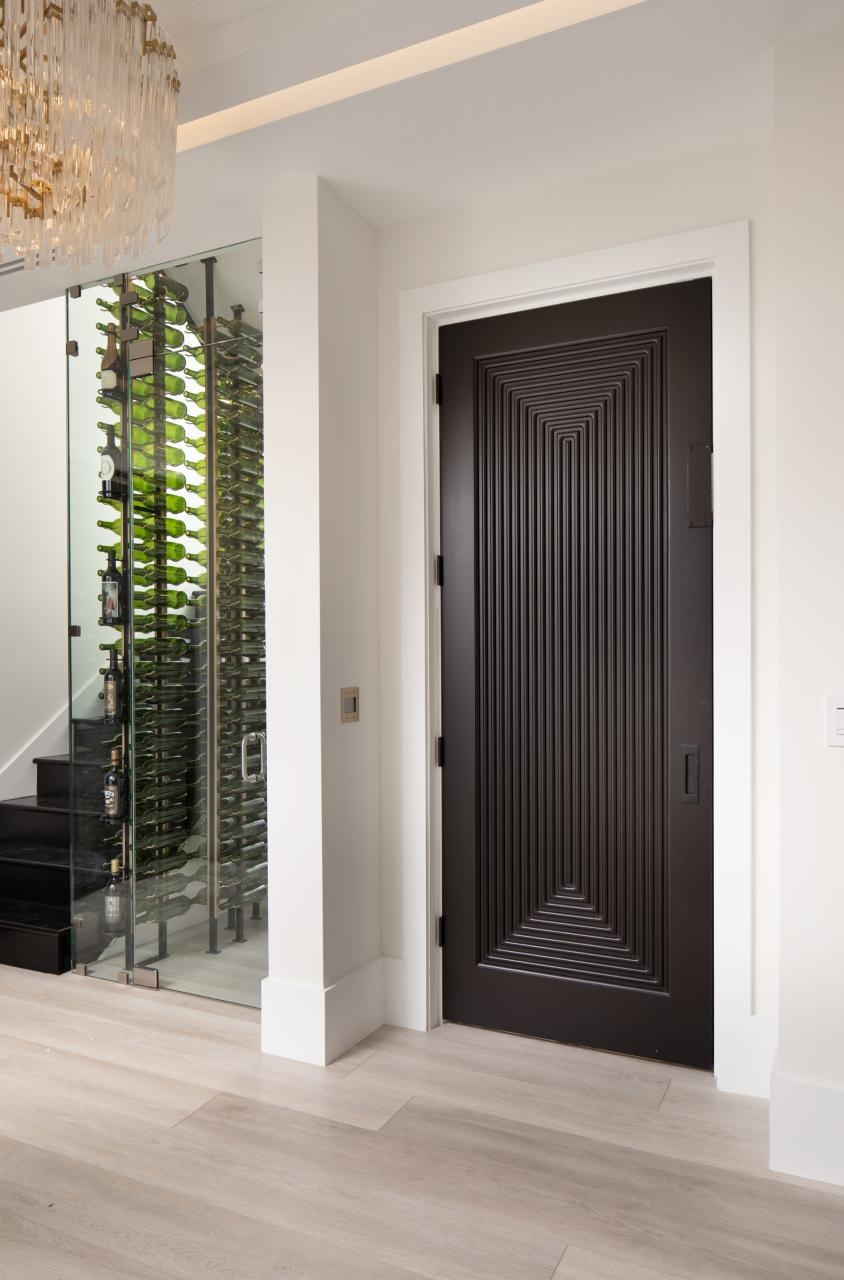
You shut the bedroom door, and the TV in the living room still comes through almost word for word. Rap on that door with a knuckle and it answers with a light, hollow knock. If that sounds like your house, you’re probably wondering what a solid core door would change, and what it would take to swap them.
A solid core door has a dense engineered-wood fill, usually particleboard, fiberboard or MDF, packed between its two faces, while a hollow core door is mostly air held in shape by a honeycomb grid. Solid core is heavier, feels sturdier, cuts noise between rooms and costs more. It suits bedrooms, bathrooms and home offices. Hollow core remains a sensible choice for closets and other low-use spaces.
What’s inside a hollow core, solid core and solid wood door
From the hallway, all three door types can look alike. The key difference is the structure between the faces:
- Hollow core: Two thin skins over a light frame, with a honeycomb grid filling most of the space inside. It’s the light, low-cost builder-grade door many homes come with.
- Solid core: The same kind of skins wrapped around a dense engineered-wood core. “Solid” describes the fill. It isn’t a slab of solid lumber.
- Solid wood: Built from separate pieces of real wood, the stiles, rails and panels you see in a traditional panel door. It’s its own category and usually costs more than solid core.
That middle option is where shoppers get tripped up. When a door is labeled “solid,” ask whether that means solid core or solid wood, because the material and the price are different.
| Hollow core | Solid core | Solid wood | |
| What’s inside | Honeycomb grid, mostly air | Dense engineered wood such as particleboard, fiberboard or MDF | Real wood stiles, rails and panels |
| Weight | Light | Often twice a hollow core door or more | Varies by wood and design |
| Sound between rooms | Lets the most through | About 3 to 7 STC points better than hollow core | Varies by design |
| Relative price | Lowest | Middle | Usually highest |
| Fits when | Closets, pantries, low-use rooms | Bedrooms, bathrooms, home offices | You want real wood throughout |
How solid core and hollow core doors differ where you notice it
You notice the difference in what you hear through the door, how it feels when it closes, and how well it holds up over the years.
Sound. This is the feature most people notice first. Doors are rated with STC, a sound transmission class number where higher means less noise gets through. Manufacturer-published ratings put solid core doors about 3 to 7 points above comparable hollow core designs, and the denser core gives better sound insulation, enough to reduce everyday noise like voices and a TV. That rating describes the door’s performance, not the room’s. Sound slips past through any gap under the door or around the frame, so a solid core door makes a room quieter without making it soundproof.
Weight and feel. A solid core door is often twice as heavy as a hollow core one, or more. That weight is what gives it a dull, settled thud in place of the hollow knock. It also puts more load on the hinges, and a heavy door may want a third hinge or sturdier ones, so ask about them when you swap.
Durability and repair. Solid core stands up to everyday knocks better, and its denser core makes the door stiffer. Many solid core doors use MDF, and MDF has one weak point: water. If moisture reaches an edge that was never sealed, MDF can swell and the skin can come loose, so in a bathroom every edge should be painted or sealed, top and bottom included. An MDF door also has lower impact resistance than solid wood, and damage to it is harder to repair invisibly.
Security and hardware. A dense core gives screws and latches more to grip, so locks and hinges hold better in a solid core door. For a bedroom or office where you want a lock that feels solid, that matters.
Where a solid core door is worth it, room by room
Solid core is worth it in rooms where you want quiet and privacy. Hollow core is fine where a door mostly hides storage:
- Bedrooms: Solid core. A bedroom off a living room or a busy hallway is where the sound difference earns its cost.
- Bathrooms: Solid core, for privacy, with every edge sealed against moisture.
- Home office: Solid core, especially if you take calls while others are home.
- Closets, pantries and utility rooms: Hollow core is fine. Nobody needs quiet from a linen closet, and you can put the savings toward the rooms that do.
- The door from an attached garage: This one is about code, not comfort.
You don’t have to choose one type for the whole house. Solid core where people sleep and work, with hollow core on the closets, is a sensible split.
The door between an attached garage and the house has its own rule. The International Residential Code (section R302.5.1 in the 2018 edition) accepts a solid wood door at least 1-3/8 inches thick, a solid or honeycomb-core steel door at least 1-3/8 inches thick, or a door with a 20-minute fire rating. A standard hollow core interior door doesn’t meet it, and the door also has to close and latch on its own. A solid core door isn’t automatically fire-rated either, since a rating applies to a labeled door and frame together. Local rules vary, so check with your city or county building department before you choose this door.
What replacing interior doors costs
Replacing an interior door generally runs about $150 to $800 per door installed, and many jobs land between $300 and $600, according to 2025 and 2026 cost guides. These are general market ranges, not a quote for your house, and they shift with the door type and the job:
| Job | Typical installed cost per door |
| Hollow core slab into your existing frame | About $150 to $400 |
| Solid core slab into your existing frame | About $250 to $650 |
| Prehung door, new frame included | About $600 to $2,000 |
| Pocket, French or oversize door | About $700 to $3000 or more |
The door itself is only part of the total. Cost guides put a hollow core slab at roughly $35 to $130 and a solid core slab at roughly $100 to $300, with higher-end solid core doors at $300 to $500 or more. Labor typically adds about $100 to $250 per door but can vary widely depending on what work needs to be done to the old door for removal.
Several factors push projects toward the top of those ranges:
- Prehung in place of a slab: A prehung door includes a new frame, which means more material and more installation work.
- Size and style: Pocket and oversize doors, and French doors with their glass inserts or decorative glass, cost the most to buy and hang.
- Hardware: New hinges, handles and locks add to the budget, and a heavier door may need sturdier hinges.
- The frame: If the old jamb is out of square, a new slab won’t hang right, and the job becomes a prehung replacement.
Can you keep your frame?
You can keep your frame and replace only the slab when the existing jamb is sound, square and lines up with the new door’s hinge and latch positions. If any of that is off, a prehung door, which arrives already hung in its own frame, is the cleaner fix.
A slab swap costs less and leaves your existing trim alone. A prehung door costs more, but it starts with a new frame that’s built to fit the door. For a professional, a prehung interior door typically takes one to two hours when the opening is square and plumb. A first-time DIYer should plan on two to four.
Choosing interior doors in St. Louis
Forshaw of St. Louis, a family business since 1871, sells and installs doors from two makers: TruStile, which makes both interior and exterior doors, and Marvin, for entry and other exterior doors. For bedrooms, baths and home offices, TruStile is the line to look at. If you’re also thinking about exterior doors, you can browse our windows and doors or read about Renewal by Andersen doors.
If you’re weighing your options room by room, come talk through the decisions at our Frontenac showroom on South Lindbergh or our Ellisville showroom on Manchester Road. Bring a list of the doors you’re thinking of replacing, and whether each one is a slab swap or a full frame, and we’ll go through them opening by opening.
Frequently Asked Questions
How much more expensive are solid core doors?
Cost guides commonly put a solid core slab at about $50 to $150 more than a comparable hollow core one, or 1.5 to 3 times the price. Installed, the gap is roughly $100 to $250 per door when a slab replaces a slab. The ranges overlap, so a well-made hollow core door can cost as much as a basic solid core one.
Are solid core doors soundproof?
No. To get a room closer to quiet, close the paths around the door. Seals along the stops and a sweep at the bottom block the gaps a heavier door can’t, and a frame that’s square lets those seals sit tight.
What is a standard core or semi-solid door?
Semi-solid generally means part of a cellular core is filled, which puts it between hollow and solid core. Makers use “semi-solid” and “standard core” differently from one brand to the next, so ask what the core is made of before you compare prices.
Is it cheaper to fix a door or replace it?
Usually fixing. Cost guides put common repairs, such as loose hinges, a door that sticks or a minor crack, at roughly $75 to $220, against about $226 to $824 to replace. Replace a door that’s warped, rotted or split, or an inexpensive hollow core door with heavy damage, since a new one can cost less than the repair.
Previous NextRELATED POSTS

Are Marvin Windows Worth…
Updated for 2026 • Based on published industry data, third-party reviews, and St. Louis dealer […]
Read More
Interior French Doors: Styles,…
A home office off the front hall can be quiet or bright, and with a […]
Read More
Outdoor Furniture in St.…
St. Charles is a community defined by its unique blend of historic charm and vibrant, […]
Read More