
Every house has a few openings that are awkward to use. There’s the window over the kitchen sink you have to lean across, the narrow strip high on a bathroom wall, and the basement window that sits just above the ground. Those are the spots where awning windows come up, usually alongside the question of whether a casement would do the job better.
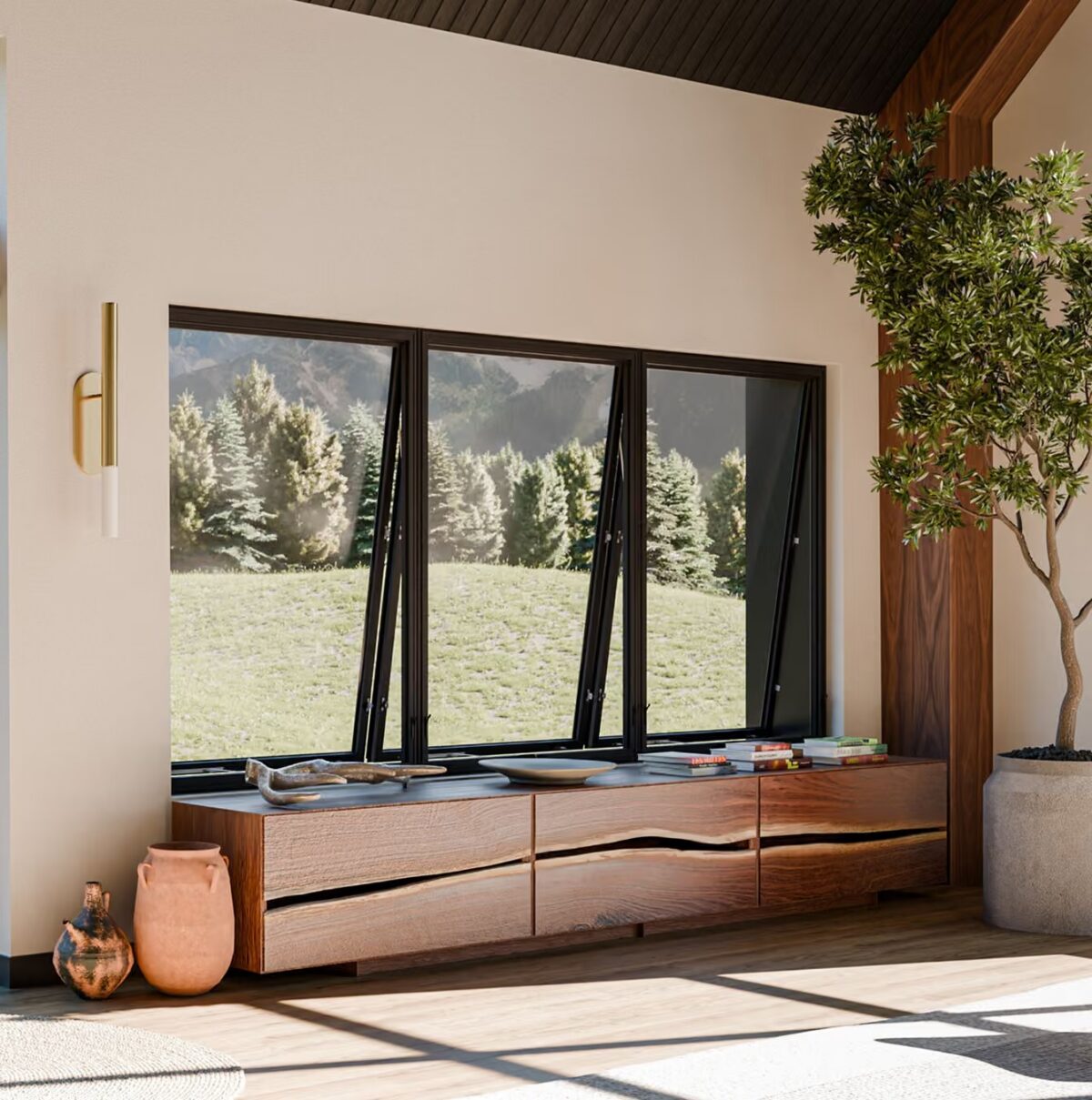
Awning windows are hinged along the top edge, so the bottom of the sash swings outward, usually with a crank at the sill. The open sash forms a small canopy, and Marvin says it shields the interior from rain while open. Awnings suit openings that are wider than they are tall: over counters, high on a wall, in bathrooms and in basements. Casements hinge on the side instead and suit taller openings.
At Forshaw of St. Louis, we sell and install both styles as a Marvin dealer, so either answer works for us. No window style is perfect for every opening, and below is how the two differ, where an awning is the right call, and where it isn’t.
How an Awning Window Works
An awning window is a single sash hinged at the top that swings out from the bottom. Andersen Windows describes it the same way, adding that most awnings open with an interior crank.
That design shapes everything else about the window:
- The sash moves outside the house. Nothing swings into the room, so blinds, faucets and countertop clutter stay out of the way.
- The crank does the reaching. Over a sink or a deep counter, you turn a handle at the sill instead of pushing up a heavy sash.
- Wide beats tall. Because the sash hangs from its top edge, awnings are made in shapes that run wider than they are tall.
- The seal is tight. When you close an awning, the sash presses against the frame on all four sides, the same way a casement does.
Awnings also pair well with other windows. Marvin shows them set high on a wall, stacked under or beside a picture window, and lined up in window walls.
Why an Awning Can Stay Open in Light Rain
An awning can stay open in a light, steady rain because the sash sits over the opening like a roof. Marvin’s own description is that awning windows “open outward from the bottom, shielding the interior from rain while open.”
That protection has a limit. Rain that falls close to straight down runs off the glass and away from the opening. Wind-driven rain is different, and it can blow in under the sash, which manufacturer and retailer guides point out as well.
In St. Louis that matters. The National Weather Service office here describes hot, humid summers, cold winters, heavy rain and strong thunderstorms. A cracked-open awning is a good way to air out a bathroom during a summer shower, but close it when a storm rolls in with wind behind it. On muggy days, open windows also bring moisture inside, so the tight seal when closed counts for more than the airflow.
Where Awning Windows Fit
Awning windows are one of several types of windows, and they work best in openings that are wide and short, or placed where you want air and light without giving up wall space or privacy.
An awning fits when:
- It’s over a kitchen sink or counter. The crank sits within reach, and the sash swings away from you instead of toward the faucet.
- It’s in a bathroom. Set high on the wall, it lets steam out and light in while keeping privacy, and it can stay open through a light rain.
- It’s high on a wall. Above a bed, a built-in or a stair landing, an awning adds light and ventilation where a taller window wouldn’t fit.
- It’s paired with a picture window. Under or beside a large fixed window, it gives the view a way to breathe.
- It’s in a basement room that doesn’t need an escape opening. A storage room, workshop or mechanical room can take an awning without the egress questions covered below.
An awning is the wrong choice in a few places. Over a deck, a walkway or the path beside your patio doors, the open sash swings into the space where people walk. In a bedroom or a finished basement room that needs an emergency escape opening, the sash can be in the way, so check the egress rules before you choose one. And on a tall, narrow opening, a casement usually fits the shape better.
Awning vs Casement Windows, Side by Side
The difference between awning and casement windows is the hinge, and the shape of your opening usually decides between them. A casement hinges on the side and opens like a door. An awning hinges on the top and opens like a canopy. Both are single-sash windows that crank open and seal tight when closed.
| Awning windows | Casement windows | |
| Hinge | Top edge | Side edge |
| Opening shape | Wider than tall | Taller than wide |
| Airflow | Steady air, protected from above | More breeze |
| Rain | Sheds light, near-vertical rain while open | No cover over the opening when open |
| Swing outside | Out and up from the bottom | Out to one side |
| Seal when closed | Compression seal on all four sides | Compression seal on all four sides |
| Locking | Handle pulls the sash into the frame | Handle pulls the sash into the frame |
| Cleaning the outside glass | Plan on reaching it from outside | Depends on the hardware; ask about the model you’re pricing |
| Escape opening | Only if the open clear size meets code, and the sash can block a window well | The same code numbers apply to the open clear size |
| Cost | Moves with size and line more than with the hinge | Moves with size and line more than with the hinge |
On energy efficiency, the two are close. Both are energy-efficient styles because they press the sash against the frame when they lock, which is why they’re generally tighter than double-hung windows. To compare two products, read each maker’s rating label for the specific window rather than leaning on the style.
Casements deserve their due. If you want as much breeze as possible, or the opening is tall and narrow, a casement is often the better window. Many houses end up with both: casements in the main rooms and awnings over the sink and in the bathrooms. Marvin makes both styles in its Essential and Vivid collections, so the two can match from room to room.
What to Check Before You Order
A few practical questions settle most awning decisions before you get to color and hardware:
- Room to swing outside. Picture the sash fully open. If it would stick out over a walkway, a deck where people sit, or a planter you water, move the awning higher or choose another style.
- Egress for bedrooms and basements. Sleeping rooms and many finished basements need an emergency escape opening. An awning’s open clear size is often smaller than its frame, and in a window well the sash can block the way out. Confirm the rules with your local building office before ordering.
- Children and second floors. On upper floors, ask about window opening control devices for the model you’re pricing.
- Cleaning. Andersen’s page says awning windows are not designed to be cleaned from the inside. On a second-story awning, think about how you’ll reach the outside glass.
All four are easier to judge in person, with an awning and a casement cranked open side by side.
If you’re also weighing materials and brands, these guides cover how long different windows last, aluminum-clad wood windows, what Fibrex is, what Andersen windows cost, how Andersen and Renewal by Andersen differ, why Renewal by Andersen windows cost so much and what Pella windows cost.
The Marvin Awning Windows We Carry
Marvin offers awning windows in its Essential, Elevate, Ultimate and Vivid collections, and the right one depends on the opening, the look you want inside and how much the project needs. We don’t carry vinyl windows (here is how fiberglass and vinyl compare), so every awning we quote is a Marvin. Two have published size limits we can point to.
| Marvin awning | Materials | Largest size Marvin lists | Performance grade |
| Essential Awning | Ultrex fiberglass inside and out | Openings up to 5′ wide by 4′ high | Up to PG40 |
| Vivid Awning | Ultrex fiberglass exterior, fiberglass-reinforced composite interior | Widths up to 6′ and heights up to 5′ | Up to PG50 |
Performance grade is a tested rating for how well a window holds up to wind and water.
Essential is Ultrex fiberglass inside and out, with four interior and six exterior colors. For most kitchen, bathroom and basement awnings, the openings fit well inside its 5′ by 4′ limit. When a project doesn’t need more than Essential offers, we say so and quote Essential.
Vivid is Marvin’s newest collection. Marvin says it’s available in select markets only, and we carry it. Its features include factory-installed screens, and the awning runs larger than Essential, to 6′ wide and 5′ high, and Marvin makes custom sizes in 1/64-inch increments. Vivid is the Marvin line to price beside Essential when the opening is bigger or the design calls for its composite interior.
Elevate and Ultimate awnings round out the range. For a room where you’d like a wood interior, Elevate puts one behind an Ultrex exterior. You can explore both in the showroom, where we’ll confirm sizes and options against your openings.
Bring your measurements or a list of the rooms, and we’ll write up an itemized quote you can take home. If you already have a quote from another company, bring it, and we’ll price both line by line. You can also browse our full range on the windows and doors page.
Frequently Asked Questions
Can an awning window be used as an escape window?
Sometimes, but it has to clear the numbers with the sash open. The International Residential Code, the model code many local governments adopt, sets a net clear opening of at least 5.7 square feet, or 5.0 at a grade-floor opening, at least 24 inches high and 20 inches wide, with the sill no higher than 44 inches off the floor, and it must open from inside without keys or tools. Local rules can differ, so check with your building office and ask for the tested egress figures of the exact product.
Is a casement window safe?
Yes, and an awning is no different. Both lock with a handle that draws the sash tight to the frame. For children, the safety device to ask about is a window opening control device: it needs two deliberate actions to release and meets ASTM F2090, which keeps the opening under 4 inches. A vent latch that holds the sash partway open is not the same thing. On the ground floor, remember that an open window of any style is still an opening.
Do awning windows come with screens?
Yes. Because the sash swings out, the screen sits on the inside of the window. It stays in place while you crank the sash open and closed.
What sizes do awning windows come in?
Most makers build them to order. Beyond Marvin’s limits above, Andersen lists custom sizing to 1/8 inch, with its A-Series awnings up to about 6 feet wide by 4 feet tall. For a replacement, the existing opening sets the size, and whether the job is insert or full-frame (our window installation team can walk you through it) decides how much of it the new window keeps.
See Awning Windows Working in Our Showroom
The quickest way to decide between an awning and a casement is to crank both open and look at the opening each one leaves. You can see the windows working at our Frontenac and Ellisville showrooms, and we’ll go through your openings with you, one window at a time.
Previous NextRELATED POSTS

Design your outdoor kitchen…
Adding an outdoor kitchen to your home is a great way to enhance your outdoor […]
Read More
Window Replacement in Ladue,…
Ladue is one of the most prestigious residential communities in the St. Louis region. If […]
Read More
Pork Chops with Spicy…
A Delectable Grilling Recipe The weather’s going to be getting warmer soon—if it hasn’t already—and […]
Read More